
Research

Ryan Marin

Within the domain of high energy theoretical physics, I am particularly interested in questions which pertain quantum gravity, black holes, and related fundamental descriptions of spacetime. I have researched these questions in the context of semiclassical thermodynamics, string theory, and low-dimensional quantum gravity.

I am excited to direct my academic focus in the future toward furthering our understanding of gravity and quantum information theory, ideally seeking to contribute to the unification process as a whole.

Nonfactorization in \( \mathrm{AdS_2} \) Quantum Gravity
TH3
Primary Advisor: Juan Maldacena
Secondary Advisor: Simone Giombi
View Full Paper
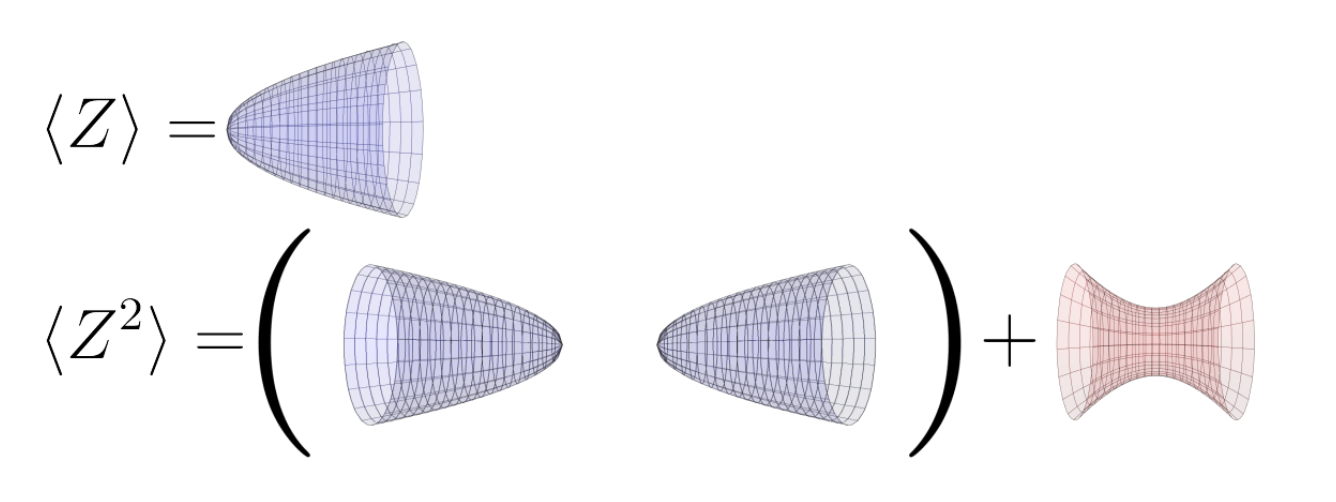
We study the phenomenon of nonfactorization in \( 1+1 \) dimensional quantum gravity through the lens of Jackiw-Teitelboim (JT) gravity and its dual construction as an \( \mathrm{SL}(2,\mathbb{R})^+ \) BF theory. After constructing the classical and quantum Hilbert space, we derive the Schwarzian boundary dynamics, interpreting their residual symmetries as underpinning boundary entanglement and nonfactorization. From the Euclidean path integral perspective, we note how nonfactorization manifests as contributions from connected bulk moduli to the topological expansion. In Lorentzian signature, we analyze nonfactorization via entanglement in the Thermofield Double state \( \ket{\mathrm{TFD}(\beta)} \) and discuss further the restrictions Lorentzian physics may impose on valid bulk moduli. Acknowledging these limitations, we outline a construction of the Saad–Shenker–Stanford matrix integral which realizes Euclidean JT gravity as dual to a nonperturbative, ensemble-averaged boundary theory. To clarify the role of the ensemble in resolving the chaotic dynamics of JT gravity, we develop a fine-grained construction of the JT path integral which incorporates the full spectra of Schwarzian dynamics. Our discussion refines the multiple mechanisms of chaos in JT gravity, though we stress the need for further nonperturbative developments to clarify the relationships between JT gravity, ensemble averaging, and quantum complexity.
Toward a resolution of the black hole information paradox: the quasi-analytic transition between self-gravitating strings and black holes
JP2
Primary Advisor: Nissan Itzhaki
Secondary Advisor: Simone Giombi
View Full Paper
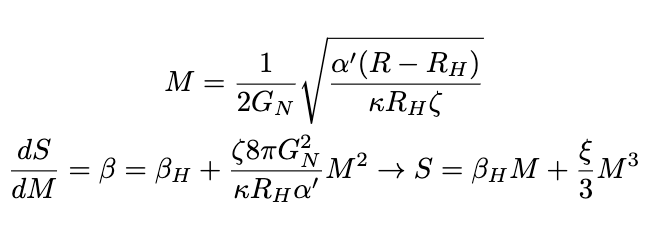
String theory has provided a powerful framework for uniting quantum gravity and semiclassical black hole thermodynamics. In this paper, we begin with the origins of the black hole information paradox in the semiclassical regime, analyzing Hawking and Bekenstein's calculation of the entropy of a black hole via quantum field theoretic techniques. We then trace the development of string theory, first through Kaluza-Klein mechanism and progressing through the computation of scattering amplitudes, eventually reaching the Horowitz-Polchinski correspondence. The final goal of this outline is to reach an understanding of the critical physics between the string and black hole scales, interpolating between self-gravitating string solutions and quantum-corrected black holes. A key result is the derivation of the Bekenstein-Hawking entropy formula from the stretched horizon and string microstate counting; we show an agreement in entropy to order unity between string states and black hole states. Particularly, we review a recent work by Chen, Maldacena, and Witten, which derives an explicit, quasi-analytic solution in a supersymmetric regime for 3 noncompact dimensions. This solution matches the black hole entropy to leading order with a cubic correction term and is valid at scales up to small deviations from the Hagedorn radius.
\( C^{k} \)-regular extremal black holes in maximally-symmetric spacetime and the third law of black hole thermodynamics
JP1
Primary Advisor: Mihalis Dafermos
Secondary Advisor: Frans Pretorius
View Full Paper | View ArXiv (preprint)
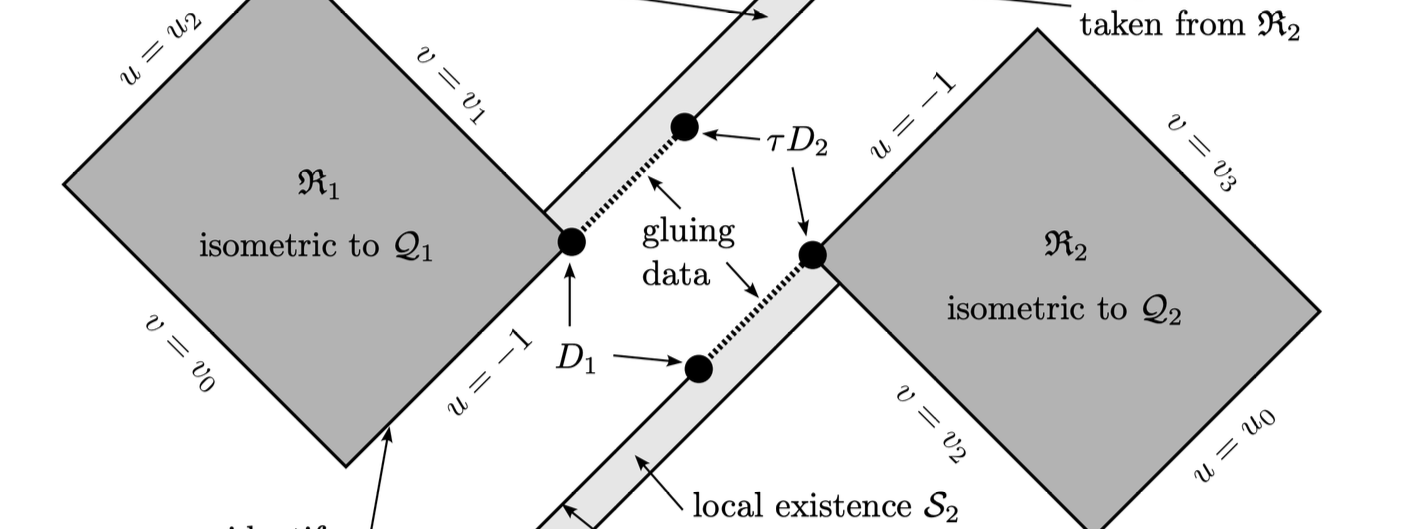
In this work we extend the proof of Ryan Unger and Christoph Kehle's 2022 work, "Gravitational collapse to extremal black holes and the third law of black hole thermodynamics", to construct examples of black hole formation from regular, one-ended asymptotically flat Cauchy data for the Einstein–Maxwell-charged scalar field system in maximally-symmetric 3+1 dimensional spacetime which are exactly isometric to \( dS_{4}/AdS_{4} \) Reissner Nördstrom black holes after a finite advanced time along the event horizon. Furthermore, the apparent horizon coincides with that of a vacuum at finite advanced time. This paper exists as an extension of the aforementioned work done by Unger and Kehle which disproves the "third law of black hole thermodynamics" originally posed by Hawking and Bardeen's "The Four Laws of Black Hole Mechanics". We begin with a brief introduction to the history of black hole thermodynamics, tracing the lineage of the third law of black hole thermodynamics up to Kehle & Unger's 2022 work; the basepoint for our extension to \( dS/AdS \) spacetime. We adapt the machinery from Kehle and Unger to Schwarzschild and Reissner-Nördstrom solutions in \( dS \), \( AdS \) space. Then, we study the relevant manifold gluing theory and reprove necessary gluing theorems in \( dS_{4} \) & \( AdS_{4} \). Finally, we provide analysis of the third law of black hole thermodynamics in these maximally symmetric spacetimes.
The Hitchin Map, Twisted \( \mathcal{N}=4 \) Super Yang-Mills Theory, and the Geometric Langlands Correspondence
457 photo
MAT457: Algebraic Geometry Final Paper
Professor: Bhargav Bhatt
View Full Paper
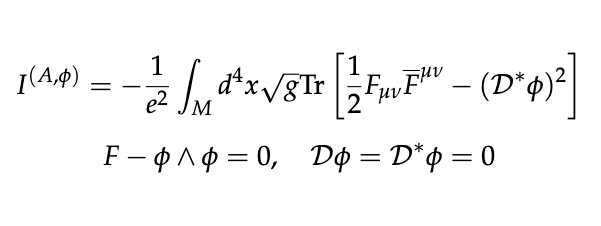
The goal of this paper is to provide a succinct overview of the Hitchin map as well as its usage in demonstrating a physics-based instantiation of the Geometric Langlands Conjecture. The first half of this paper seeks to introduce the relevant mathematical machinery necessary to understand the Hitchin map in its original form. This analysis also includes a discussion on the integrability of the map, as well as its fibrations and associated spectral curves. The second half of this paper is dedicated to understanding the Hitchin map's presence under a particular “twisting” of \( \mathcal{N} = 4 \) Supersymmetric Yang-Mills (SYM) theory. We discuss the process of compactification and “GL-twisting”. from which the Hitchin map arises naturally in Super Yang-Mills with the goal of appreciating it as a mathematical bridge between Montonen-Olive \( \mathcal{S} \)-duality and the Geometric Langlands conjecture.